Intel, Samsung, TSMC Race in Cutting-Edge Processes

Release time:2023-10-18
author:AMEYA360
source:trendforce
reading:2328

  Driven by emerging technologies like AI and high-performance computing, the semiconductor foundry industry increasingly emphasizes the importance of advanced manufacturing processes. Recently, the industry has seen significant developments. Intel announced that it has commenced large-scale production of its Intel 4 process node, while TSMC and Samsung are equally committed to advancing their advanced process technologies.
Intel, Samsung, TSMC Race in Cutting-Edge Processes

  Intel’s Mass Production of Intel 4 Process Node

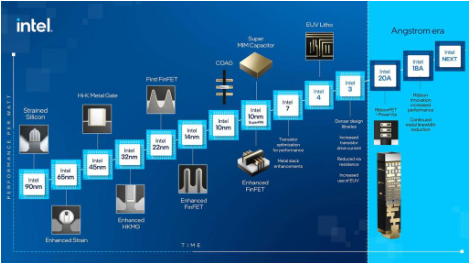
  On October 15th, Intel China’s official public account revealed that Intel has initiated large-scale production of the Intel 4 process node using Extreme Ultraviolet Lithography (EUV) technology. According to Intel, they are making significant progress with their “Four Years, Five Nodes” plan. This plan aims to produce next-generation products that meet the computational demands driven by AI’s role in the “Siliconomy.”

  Being the first process node produced by Intel using EUV lithography technology, Intel 4 offers substantial improvements in performance, efficiency, and transistor density compared to its predecessors. Intel 4 was unveiled at the Intel Innovation 2023 held in September this year.

  In comparison to Intel 7, Intel 4 achieves a 2x reduction in area, providing high-performance computing (HPC) logic libraries and incorporating various innovative features.

  In detail, Intel 4 simplifies the EUV lithography process, optimizing it for high-performance computing applications, supporting both low voltage (<0.65V) and high voltage (>1.1V) operations. Compared to Intel 7, Intel 4 boasts more than a 20% improvement in iso-power performance, and high-density Metal-Insulator-Metal (MIM) capacitors deliver outstanding power supply performance.

  Intel’s “Four Years, Five Nodes” plan is advancing with the following process updates:

  Intel 7 and Intel 4 are currently in large-scale production. Intel 3 is on track to meet its planned target by the end of 2023.

  Intel’s Intel 20A and Intel 18A, which use Ribbon FET all-around gate transistors and PowerVia backside power delivery technology, are also progressing well, with a target of 2024. Intel will soon introduce the Intel 18A process design kit (PDK) for Intel Foundry Services (IFS) customers.

  With the adoption of Intel 4 process nodes, the Intel Core i9 Ultra processor, codenamed “Meteor Lake,” will be released on December 14th this year, ushering in the AIPC era.

  On Intel 3 process nodes, the energy-efficient E-core Sierra Forest processor will be launched in the first half of 2024, and the high-performance P-core Granite Rapids processor will follow closely.

  Samsung’s 2nm Process Detailed Production Plan

  Samsung has already commenced production of its second-generation 3nm chips and plans to continue focusing on 2nm chips.

  On June 28th, Samsung Electronics unveiled its latest foundry technology innovations and business strategies at the 7th Samsung Foundry Forum (SFF) in 2023.

  In the era of artificial intelligence, Samsung’s foundry program, based on advanced GAA process technology, offers robust support for customers in AI applications. To this end, Samsung has disclosed a detailed production plan and performance levels for its 2nm process. The plan is to achieve mass production for mobile applications by 2025 and respectively expand to HPC and automotive electronics in 2026 and 2027.

  Samsung reports that the 2nm process (SF2) improves performance by 12% compared to the 3nm process (SF3), increases efficiency by 25%, and reduces the area by 5%.

  Furthermore, reports indicated that Samsung is ensuring the production capacity for products using the next-generation EUV lithography machine, High-NA, in September. This equipment is expected to have a prototype by the end of this year and officially enter production next year.

  TSMC’s Mass Production of 2nm by 2025

  This year, TSMC has unveiled its latest advanced semiconductor manufacturing roadmap in various locations, including Santa Clara, California, and Taiwan. The roadmap covers a range of processes from 3nm to 2nm.

  TSMC’s current roadmap for 3nm includes N3, N3E, N3P, N3X, and N3 AE, with N3 serving as the foundational version, N3E as an enhanced version with further cost optimization, N3P focusing on improved performance with a planned start in the second half of 2024, N3X targeting high-performance computing devices with a mass production goal in 2025, and N3 AE designed specifically for the automotive sector, offering greater reliability and the potential to shorten time-to-market by 2-3 years.

  In the 2nm realm, TSMC is planning to achieve mass production of the N2 process by 2025. TSMC has reported that the N2 process will offer a 15% speed improvement over N3E at the same power or a 30% reduction in power consumption, with a 15% increase in transistor density. In September, media reports revealed that TSMC has formed a task force to accelerate 2nm pilot production and mass production, aiming for risk production next year and official mass production in 2025.

  To ensure the smooth development of 2nm process technology, TSMC has initiated efforts in the upstream equipment sector. On September 12th, TSMC announced the acquisition of a 10% stake in IMS Nanofabrication, a subsidiary of Intel, for a price not exceeding $432.8 million. IMS specializes in the research and production of electron beam lithography machines, which find extensive applications in semiconductor manufacturing, optical component manufacturing, MEMS manufacturing, and more. The industry sees TSMC’s IMS acquisition as vital for developing crucial equipment and meeting the demand for 2nm process commercialization.

("Note: The information presented in this article is gathered from the internet and is provided as a reference for educational purposes. It does not signify the endorsement or standpoint of our website. If you find any content that violates copyright or intellectual property rights, please inform us for prompt removal.")

Online messageinquiry

reading
TSMC Rejects High-NA EUV Investment Concerns, Confirms Purchase for R&D Use
  As Intel advances its High-NA EUV roadmap for its A14 node, market attention has turned to TSMC’s comparatively cautious approach to the cutting-edge lithography tool, which is estimated to cost around US$400 million per system.  However, at its June 4 shareholder meeting, TSMC Chairman C.C. Wei rejected speculation that the company had opted not to invest in High-NA EUV. According to TechNews, he stressed that TSMC has already purchased the equipment and is actively conducting R&D.  Wei explained that the main reason the High-NA EUV system has not yet been introduced into mass production is purely cost-related. The company will continue working to improve efficiency and reduce costs, and will move the technology into production once conditions are ready, TechNews reports.  Interestingly, Wei also added with a touch of humor that TSMC is not only investing in the technology but has already purchased the tools, noting that “it would even be a bit embarrassing to say how many.” As previously reported by Tom’s Hardware, citing Kevin Zhang, senior vice president of business development and global sales and deputy COO at TSMC, TSMC’s upcoming A13 and A12 processes, both targeted for 2029, are not expected to require High-NA EUV lithography tools.  This contrasts with Intel’s strategy for its 14A node and subsequent generations, which are set to adopt High-NA EUV starting in 2027–2028, according to Tom’s Hardware. Reuters, citing ASML CEO Christophe Fouquet, also reported in May that the semiconductor equipment giant expects to see the first memory and logic products manufactured on High-NA EUV systems within the next few months.  TSMC Reaffirms Strong Capex Outlook  Against this backdrop, TSMC reaffirmed its capital expenditure plans to support sustained growth. According to TechNews, when investors asked Chairman C.C. Wei how long the company’s current investment cycle would last and when a potential “plateau period” might emerge, he said TSMC remains highly confident in its multi-year outlook, supported by forecasts from both customers and “customers’ customers,” with the company’s growth trajectory expected to continue upward.  He noted that, as previously guided at the earnings call, capital expenditure for 2026 is projected to range between US$52 billion and US$56 billion, with an internal bias toward the upper end of US$56 billion, as noted by the report.  Liberty Times adds that at TSMC’s annual shareholder meeting, C.C. Wei said in his opening remarks that the company achieved record-high revenue and profit last year, delivering strong operational results. He noted that TSMC’s share price has risen by more than 1.5 times over the past year, while cash dividend payouts have increased by over 30%.
2026-06-05 10:44 reading:191
TSMC, Sony to Form JV for Image Sensors, Including New Production Lines for AI and Automotive Use
  As TSMC has decided to upgrade its 2nd Kumamoto fab to 3nm, the foundry giant is also exploring to secure more opportunities for its mature nodes in Japan. According to its press release on May 8, Sony and TSMC announced the signing of a non-binding memorandum of understanding (MOU) to establish a strategic partnership focused on the development and manufacturing of next-generation image sensors.  Notably, under the proposed framework, the two companies plan to form a joint venture (JV), with Sony serving as the majority and controlling shareholder. The JV is expected to build development and production lines at Sony’s newly constructed fab in Koshi City, Kumamoto Prefecture.  TSMC said that beyond manufacturing expansion, the partnership is also aimed at exploring emerging opportunities in physical AI applications, including automotive and robotics.  Through this collaboration, Sony will contribute its deep expertise in image sensor design, while TSMC will bring its advanced process technology and large-scale manufacturing capabilities. Both sides aim to combine their respective strengths to further enhance the performance and competitiveness of future image sensor technologies.  The move aligns with an April Reuters report, which noted that Japan’s Ministry of Economy, Trade and Industry (METI) has confirmed that the Japanese government will provide subsidies of up to ¥60 billion (approximately US$380 million) to Sony Semiconductor Solutions Corporation for the construction of an image sensor facility in Kumamoto Prefecture, western Japan.  Sony is a long-time customer of TSMC. As previously reported by Commercial Times, TSMC’s first Kumamoto fab—entering mass production in late 2024—supplies logic chips to Sony and DENSO, using 22/28nm and 12/16nm process technologies.  Separately, Sony has recently begun restructuring efforts, including a spin-off of its television business. Its CIS (image sensor) unit is also facing rising competitive pressure, as Samsung Electronics continues to expand its share in supplying image sensors for Apple, prompting Sony to seek new growth momentum in the segment, Commercial Times added.
2026-05-09 10:16 reading:868
TSMC Hints at Potential Further U.S. Expansion; Industry Sources Reportedly See Up to US$250B Investment
  As TSMC continues expanding its U.S. footprint, comments from Cliff Hou, TSMC Senior Vice President and Deputy Co-COO, have caught industry attention. According to Commercial Times, Hou said at the 2026 SelectUSA Investment Summit that the company “is prepared for growth from any new business opportunities,” remarks the market has interpreted as signaling potential further expansion of TSMC’s U.S. investments. TSMC’s total U.S. investment currently stands at US$165 billion.  Commercial Times notes that supply chain developments show chip equipment suppliers have also begun establishing U.S. subsidiaries to support TSMC. Industry sources added that TSMC’s total U.S. investment could reach as much as US$250 billion, with the company expected to replicate the Hsinchu Science Park cluster model in Phoenix.  Meanwhile, Economic Daily News reported that TSMC’s first Arizona fab entered mass production in 4Q24, while its second fab has already been completed and is expected to begin 3nm mass production in the second half of 2027. TSMC previously said construction of its third Arizona fab is already underway, while permits are being sought for a fourth fab and its first advanced packaging facility in the state. The report also noted that TSMC has acquired a second large parcel of land near its existing Arizona site to support future expansion plans.  Although TSMC’s U.S. fabs are more costly, capacity remains in strong demand, with previous reports indicating that customers had already reserved capacity at all four Arizona fabs, as noted by Economic Daily News. Institutional investors said that, for process technologies below 2nm, TSMC’s related capacity ratio between Taiwan and the U.S. is expected to reach roughly 7:3 by 2030.  TSMC Reshapes Board Amid Global Expansion  In addition, TSMC has also recently adjusted its board structure. According to Commercial Times, the company plans to revise its corporate charter by increasing the number of board seats from the current seven to ten directors to nine to twelve, with the proposal set to be discussed at the shareholders’ meeting on June 4.  The move reflects TSMC’s response to the rapidly changing global business environment and is intended to provide greater flexibility in recruiting directors from diverse professional backgrounds, the report said. It also noted that, as TSMC rapidly expands overseas and continues increasing its U.S. investments, the board will need more members with expertise in international supply chains, geopolitics, and U.S. policy.
2026-05-07 13:22 reading:494
Intense Competition in Advancing Processes at the 2nm by Samsung, Intel, and TSMC
  According to TechNews’ report, Gitae Jeong, Vice President of Samsung Electronics, recently revealed in an interview that the company is set to introduce the SF1.4 (1.4nm) process, expected to enter mass production in 2027.  This announcement intensifies the competition in advanced semiconductor manufacturing, particularly in the development of 2.5D/3D integrated heterogeneous structure packaging among the three major semiconductor foundry giants.  *TSMC: N3P Process Superior to Intel 18A, N2 to Lead Industry’s Advanced Processes  Previously, the semiconductor industry reported challenges with both TSMC and Samsung achieving yields above 60% for their 3nm processes due to undisclosed issues. TSMC’s yield was reported to be only 55%, below the normal yield rate.  However, TSMC’s President, C.C. Wei, expressed optimism, stating that current N3 demand is better than three months ago, contributing to a healthy growth outlook for TSMC in 2024.  Wei also anticipates that TSMC’s 3nm process will contribute a mid-single-digit percentage (4%-6%) to the company’s annual wafer revenue in 2023.  Regarding competition with rival Intel’s 18A process, Wei believes that TSMC’s N3P process offers better performance, power, and area (PPA), alongside improved cost efficiency and technical maturity. Furthermore, TSMC’s upcoming N2 process is expected to be the industry’s most advanced when introduced.  *Intel: Striving for the Fourth Customer for 18A Process Outsourcing Orders  Intel’s CEO, Pat Gelsinger, has revealed that the 18A process has secured orders from three customers and aims to acquire a fourth customer by the end of the year. The advanced 18A process is scheduled to begin production at the end of 2024, with one customer already having made an advance payment. External expectations suggest that the customer could possibly be NVIDIA or Qualcomm.  Intel has stated that Intel 4 and Intel 3 processes are similar, as are Intel 20A and Intel 18A processes. Consequently, Intel’s primary focus will be on offering Intel 3 and Intel 18A to semiconductor foundry customers. Meanwhile, Intel 4 and Intel 20A processes are more likely to be used internally. However, Intel is open to accommodating customer requests if they express interest in adopting these later processes.  *Samsung: Commencing Mass Production of SF2 in 2025, Prioritizing Internal Use  Due to challenges with the three-nanometer (3nm) manufacturing process, there have been reports that Samsung plans to shift directly to the more advanced two-nanometer (2nm) process.  According to Samsung’s Foundry Forum (SFF) plan, they will begin mass production of the 2nm process (SF2) in 2025 for mobile applications, expand to high-performance computing (HPC) applications in 2026, and further extend to the automotive sector and the expected 1.4nm process by 2027.  Similar to Intel, Samsung intends to prioritize the production of its own products using the 2nm process. The 2nm process products will initially be utilized for Samsung’s in-house products rather than external customer products.  *Summary  While TSMC’s N3 series currently enjoys broad support, including N3E, N3X, and N3P process series, the move to 2nm introduces new variables as it adopts a completely new GAAFET architecture. Regardless, whether it’s TSMC’s N2, Intel’s 18A, or Samsung’s SF2, each of them possesses its competitive strengths. The industry is also eagerly anticipating the future developments in advanced semiconductor processes.
2023-11-03 14:50 reading:2334
  • Week of hot material
  • Material in short supply seckilling
model brand Quote
BD71847AMWV-E2 ROHM Semiconductor
MC33074DR2G onsemi
TL431ACLPR Texas Instruments
CDZVT2R20B ROHM Semiconductor
RB751G-40T2R ROHM Semiconductor
model brand To snap up
STM32F429IGT6 STMicroelectronics
IPZ40N04S5L4R8ATMA1 Infineon Technologies
TPS63050YFFR Texas Instruments
BP3621 ROHM Semiconductor
BU33JA2MNVX-CTL ROHM Semiconductor
ESR03EZPJ151 ROHM Semiconductor
Hot labels
ROHM
IC
Averlogic
Intel
Samsung
IoT
AI
Sensor
Chip
About us

Qr code of ameya360 official account

Identify TWO-DIMENSIONAL code, you can pay attention to

AMEYA360 weixin Service Account AMEYA360 weixin Service Account
AMEYA360 mall (www.ameya360.com) was launched in 2011. Now there are more than 3,500 high-quality suppliers, including 6 million product model data, and more than 1 million component stocks for purchase. Products cover MCU+ memory + power chip +IGBT+MOS tube + op amp + RF Bluetooth + sensor + resistor capacitance inductor + connector and other fields. main business of platform covers spot sales of electronic components, BOM distribution and product supporting materials, providing one-stop purchasing and sales services for our customers.

Please enter the verification code in the image below:

verification code